
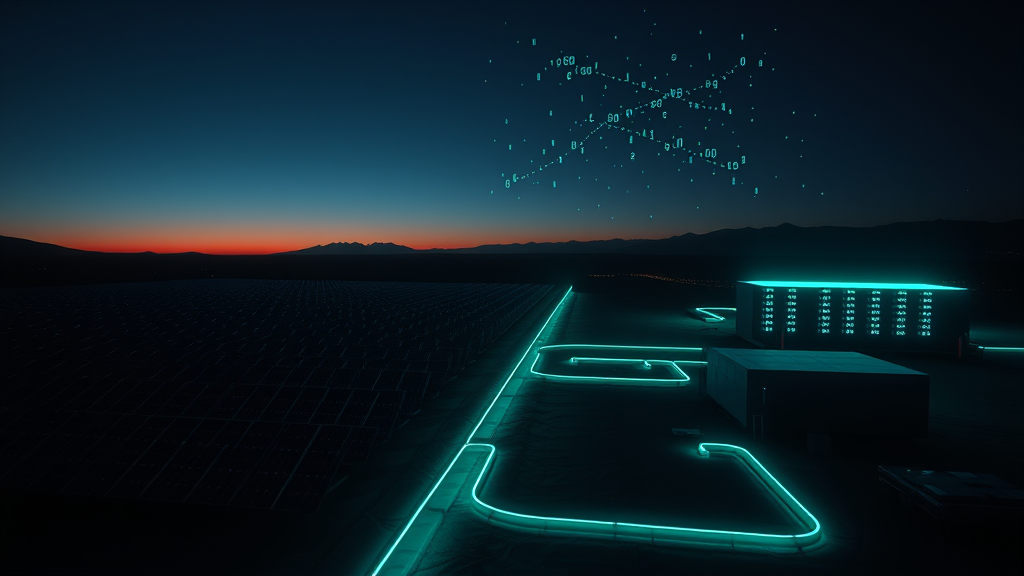
Proof-of-work mining has always had a straightforward relationship with energy: the cheaper and more abundant the power, the more secure the network. A new initiative wants to make sure Kaspa's energy future runs on sunlight from the desert rather than coal from a plant.
On April 10, 2025, KasMedia published a detailed article by Nicholas Sismil and Jennifer Ghelardini outlining the Kaspa Industrial Initiative — Kii — and its connection to Dii Desert Energy, an industry network of over 120 international companies working to build the largest clean-energy market in North Africa and the Middle East (source). The piece lays out how Kaspa's proof-of-work design makes the protocol a natural partner for renewable energy infrastructure in the world's sunniest regions. For KAS holders and PoW miners, it is worth understanding what this initiative actually proposes, what it relies on, and where the real implications lie.
The Problem: PoW Mining Needs Cheap, Clean Energy
The global energy system still runs primarily on fossil fuels — coal, oil, and natural gas — supplying roughly 160,000 TWh of demand worldwide. That model faces mounting pressure from price volatility, geopolitical risk, resource constraints, and climate concerns.
Proof-of-work miners feel these pressures acutely. Mining is an energy-intensive business by design; the computational work that secures the chain is inseparable from the electricity bill. When energy costs spike, marginal miners shut down. When energy is cheap and abundant, hashrate grows and network security strengthens. The economics are unforgiving and simple.
Kaspa's design amplifies this relationship. The protocol uses the kHeavyHash algorithm, and the source article references ongoing development of optical-proof-of-work ASIC-specific miners optimized for it. As specialized hardware drives efficiency gains, the remaining variable — and the one that determines where mining concentrates geographically — is the cost of electricity.
The article frames the core principle plainly: the energy securing Kaspa must be "abundantly available, climate neutral, and as cheap as possible." That is not a slogan. It is an operational constraint that shapes where mining can viably happen at scale.
The Geography of Cheap Solar
The most favorable location for that constraint turns out to be well-defined. The Sahara Desert and the broader North African and Middle Eastern region receive some of the highest solar irradiance on Earth. According to the work of Emeritus Professor Ad Van Wijk, cited in the article, the Sahara averages 3,600 hours of sunshine per year, with some areas reaching 4,000 hours. Van Wijk's research — published under titles like "Hydrogen: The Bridge Between Africa and Europe" and "Green Hydrogen For a European Green Deal: A 2x40 GW Initiative" — suggests that covering only a few percent of the Sahara with solar panels could theoretically produce enough energy to meet the entire world's demand of 160,000 TWh.
That is a theoretical ceiling, not a near-term plan. But it illustrates why this region matters: the marginal cost of solar electricity in the Sahara, once panels are installed, approaches zero. For a proof-of-work network seeking the cheapest possible energy input, the desert is not a romantic idea — it is a spreadsheet argument.
Dii Desert Energy and the Clean Energy Market
Dii Desert Energy has been working on this problem since 2009, originally under the Desertec Industrial Initiative. The organization now operates as a network of more than 120 international companies whose goal is to enable a large-scale clean energy market in North Africa and the Middle East.
Dii focuses on two categories of clean energy output, which the article distinguishes carefully:
- Green electrons — renewable electricity from solar, wind, hydro, geothermal, and biomass sources, delivered to local or interconnected power grids.
- Green molecules — energy carriers like hydrogen (produced by electrolysis using renewable electricity), liquid e-fuels, and solid iron powder. These can store and transport renewable energy over long distances without greenhouse gas emissions.
The distinction matters. Solar panels in the Sahara produce electricity, but electricity is hard to ship across the Mediterranean without transmission infrastructure. Hydrogen — produced on-site by splitting water with solar power — can be transported, stored, and converted back to electricity through fuel cells or used directly in industrial processes. It is, in effect, a way to move desert sunlight to where it is needed.
Dii's sister initiative, ZETA Global (Zero Emissions Traders Alliance), works specifically on regional and global trade of these clean energy products: electrons and molecules alike.
Kii: The Kaspa Industrial Initiative
Against this backdrop, the article introduces Kii — the Kaspa Industrial Initiative — described as a complementing industry effort that enables Kaspa applications in industry generally, and in the green financial and energy industry specifically.
The connection to Dii is direct. Kii positions Kaspa's proof-of-work mining as a natural buyer of renewable energy from desert solar installations. The logic is circular in a useful way: cheap renewable energy makes mining viable, and mining provides a consistent baseload demand that helps justify renewable energy infrastructure investment.
The article does not provide operational details — no specific mining facilities, no signed power-purchase agreements, no hashrate projections. What it does provide is a strategic framing: Kaspa's community should view energy sourcing as a first-order concern, not an afterthought. The development of specialized ASIC hardware for kHeavyHash makes energy cost the dominant variable in mining profitability, and Kii is presented as the initiative meant to address that variable at scale.
What This Means for PoW Miners
For miners currently running Kaspa operations, the Kii announcement is forward-looking rather than immediately actionable. No new energy contracts or mining facilities are described. The significance lies in direction and intent.
If Kii succeeds in connecting Kaspa mining to large-scale desert solar and green hydrogen infrastructure, the implications would be structural:
Lower energy floors. Renewable solar in North Africa has among the lowest levelized costs of electricity globally. If Kaspa mining gravitates toward these sources, the energy cost baseline for the network drops, which affects the profitability calculus for every miner everywhere.
Geographic decentralization of hashrate. Mining today concentrates heavily in regions with cheap fossil-fuel electricity. A viable renewable-energy alternative in a different geography could redistribute hashrate, which improves network resilience.
Longer investment horizons. Fossil-fuel energy prices are volatile and subject to geopolitical shocks. Solar installations in politically stable desert regions with long-term power-purchase agreements offer more predictable cost structures for mining operations that need to plan in years, not quarters.
Miners and KAS holders who secure their own keys are already thinking long-term. If you hold KAS and want to protect it with a time-delayed withdrawal — so that any unauthorized transfer gives you a window to react — Kaspa Safe is an on-chain covenant vault built on Kaspa Toccata where you choose the delay and an alarm key can cancel theft in progress. The vault is an on-chain contract; keys never leave your device.
Green Hydrogen: Promising but Not Yet Competitive
The article is careful to note a real constraint: green hydrogen, while "revolutionary," will reach cost competitiveness "as soon as carbon emission costs will be factored in properly into the markets" — for example, through cap-and-trade schemes or carbon taxes.
Today, most hydrogen is still "gray" — produced from natural gas via steam methane reformation, with CO₂ released as a byproduct. An emerging alternative, "blue" hydrogen, captures the carbon, but the process does not entirely eliminate greenhouse gas emissions. Neither qualifies as renewable.
Green hydrogen — produced by electrolysis using renewable electricity — is genuinely net-zero. But it is more expensive than its fossil-derived alternatives in most markets without carbon pricing. The article acknowledges this honestly. For Kaspa mining to use green hydrogen as an energy carrier (rather than direct solar electricity), the economics need to close. That is a policy question as much as a technology question.
Honest Assessment: Vision vs. Execution
The Kii initiative is at an early stage. The source article is a strategic vision piece, not an operational update. It does not report completed infrastructure, signed agreements, or measured hashrate running on desert solar. What it does is articulate a thesis: that Kaspa's proof-of-work design, combined with the falling cost of desert solar and the emerging green hydrogen economy, creates a natural alignment between network security and clean energy.
For KAS holders and miners who care about the long-term trajectory of the network, this thesis is worth tracking. The energy source behind proof-of-work mining is not an abstraction — it directly affects hashrate distribution, mining centralization, network security, and the political durability of the chain. A PoW network powered by renewable energy faces fewer regulatory headwinds than one running on coal plants.
The Kaspa community has historically focused on protocol-level innovation — the GHOSTDAG consensus, rapid block times, the Toccata covenant upgrade. Kii represents a different kind of investment: not in code, but in the physical infrastructure that underwrites the network's security model. Whether it delivers will depend on execution, partnerships, and energy market dynamics that extend well beyond the blockchain.
For now, it is a signal worth noting. The people building Kaspa are thinking about where the electricity comes from, not just what the software does. That is a maturity indicator for any proof-of-work network — and one that miners who pay attention to their energy contracts will appreciate more than most.
Continue exploring
Kaspa Forge transaction architecture
Next useful step: continue with the protocol documentation
FAQ
What is the Kaspa Kii initiative?
Kii stands for Kaspa Industrial Initiative. It aims to enable Kaspa applications in industry, with a particular focus on green finance and clean energy sectors.
How does Dii Desert Energy relate to Kaspa mining?
Dii Desert Energy is a network of 120+ international companies building a clean energy market in North Africa and the Middle East. Kii is a complementing initiative that connects Kaspa's proof-of-work mining to this renewable energy infrastructure.
Why does proof-of-work mining need cheap renewable energy?
Kaspa's security model relies on unforgeable costliness from mining. For that costliness to remain sustainable and decentralized, the energy powering it should be abundant, climate-neutral, and as inexpensive as possible.
What is green hydrogen and why does it matter for Kaspa?
Green hydrogen is produced by electrolysis using renewable electricity to split water into hydrogen and oxygen. It can store and transport solar energy from deserts globally, making it a viable energy carrier for remote mining operations.
Does Kaspa Kii change how KAS holders interact with the network?
Not directly. Kii is an industry-facing initiative focused on energy sourcing for mining. For KAS holders, it signals a long-term commitment to sustainable, low-cost mining — which strengthens network security over time.
Put your KAS where theft can be cancelled
A covenant vault on Kaspa mainnet: your keys, your rules, our tooling. Free on-chain, forever.
Create a vault